Our capacity to deliver energy reliably, expand our footprint and responsibly pursue growth is supported by strong, long-term partnerships with over 100,000 landowners who grant us the privilege of securing permanent easements on private land. We are committed to cultivating sustainable and mutually beneficial relationships with landowners.
We implement a consistent approach to engaging with affected landowners for proposed pipeline infrastructure projects. Early engagement, both proactive and in compliance with regulatory requirements, provides time to explain the project, secure land survey permissions and facilitate a formal negotiation process. We invite landowners to ask questions, express concerns and share their preferences to help develop mutually beneficial solutions.
Encroachments
Common Encroachments
Permitted, with exception
Fencing
Landscaping
Roads, streets and driveways
Not permitted
Drainage and septic
Aboveground structures
Pools and ponds
Call Before You Dig
Call 811 before beginning and excavation project, no matter how big or small the project is.
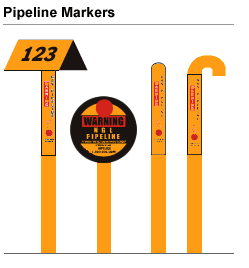
Most of our pipelines are buried for safety reasons. To identify them, look for the line markers like those shown below. We install markers at roads, rail and river crossings and other places along the right of way. Markers show the line’s approximate location and they also provide emergency contact information.
Markers help identify the general vicinity of pipelines; however, precise details such as pipeline depth, number and exact location must be obtained by calling your state One-Call, 811. Keep in mind that pipelines may not follow a straight path between markers.
Look for these signs:
Painted metal or plastic posts
Signs located near roads, railroads and along pipeline right-of-ways
Pipeline casing vent
Marker for pipeline patrol airplane
In addition to looking for markers, the public can search for pipelines in their community by referencing the National Pipeline Mapping System. Enter your state and county and NPMS will provide a list of pipelines, their location, general commodities transported and operator contact information.
Please note: this site does not currently map gas gathering or distribution pipelines.
The Landowner FAQs is for information purposes only and is intended to address commonly asked questions but doesn’t address all potential landowner questions and concerns. A Williams representative will contact landowners that may be impacted by a pipeline project about the need for acquisition of easement rights and the formalization of such acquisition in a definitive easement agreement. These Landowner FAQs do not create a binding or enforceable contract and may not be relied upon by a party as the basis for a contract.
Construction QUESTIONS
Easement: The interests in land owned by a person other than the person that has title to the fee simple interest in the land, consisting of the right to use or control the land or an area above or below it, for a specific limited purpose (such as the right to install, maintain and operate a pipeline or related facilities).
Right-of-way: Is a person’s legal right, established by usage or by contract, to pass through grounds or property owned by another.
This right is incidental to or a part of the easement interests that will be conveyed to Williams and may be referred to as the access or road easement, easement area or right-of-way.
The amount of land required for a pipeline easement will vary depending on various factors of the project and the land. Some of these factors may include size of pipeline or related facility, route, topography, soil conditions and regulatory requirements.
Williams’ Land Representative will discuss the land requirements with the landowner during the easement agreement negotiations and the easement area along the pipeline and related facilities will be described in the easement agreement.
Any temporary workspace reverts back to the landowner upon completion of the pipeline or related facility construction and easement area restoration.
Before starting any work, the law requires you to call your local ‘One-Call’ center to tell them when and where you plan to dig by dialing 811.
The One Call center will notify the appropriate local company personnel who are responsible for locating the facilities within their area.
No surface-disturbing activities should take place on the easement area prior to company personnel locating the facilities.
The easement agreement applicable to that pipeline should describe the width of an existing easement.
A survey of your property may also indicate the easement width, although some surveys may not include that level of detail.
If none of this information is available, contact Williams at 1-800-Williams or here.
Crowheart Information
Mailing Address:
Williams Attn: Upstream Owner Relations One Williams Center PO Box 2400 Tulsa, OK 74102-2400
This document is a sworn statement providing information about a deceased owner regarding their marital history, children, and any possible heirs to their interest and is sworn by the person completing the form. It must be completed by a disinterested third party with personal knowledge of the family history.
For convenience, Williams can provide a sample Affidavit of Heirship form that we accept internally; however, use of our form is optional, and you may submit an affidavit prepared by your attorney or other qualified professional.
For Williams’ internal ownership records and payment/title review purposes, we require that the Affidavit of Heirship be recorded in the county in which the deceased held an interest.
As part of our internal documentation policy for payment processing, accounts that have paid more than $5,000 in royalties annually typically require probate documentation in the state in which the deceased held an interest; in other situations, an Affidavit of Heirship may be acceptable for our review.
A recorded Affidavit of Heirship serves as fact evidence but is not a legal transfer or conveyance of the underlying real property interest; we may require further curative action be taken and filed of record.
This information is provided for general informational purposes only and is not intended as legal advice. Williams does not provide legal advice, and you may wish to consult your own legal counsel regarding probate, affidavits, or other estate matters.
Please contact us for further information regarding a deceased owner.
Click here for instructions on how to complete the Affidavit of Heirship.
The Affidavit of Death and Heirship form is also available to download.
ACH/Direct Deposit: Please fill out this ACH Form and submit with a copy of a voided check to our Owner Relations Department at Upstream.Owner.Relations@Williams.com or mail to:
W9: Is the form used to request a taxpayers’ social security number and/or EIN.
The information below is provided for general informational purposes only. Documentation requirements may vary depending on individual circumstances, and additional documentation may be requested.
Owner Died With a Will (Testate) — Probate Completed.
When an owner dies with a will and probate has been completed in the state where the property is located, Williams will typically request the following documentation for ownership verification and payment purposes.
Documents Typically Requested:
Copy of Death Certificate
Copy of the Last Will and Testament
Order Admitting the Will to Probate
Letters Testamentary
Copy of the Recorded Deed of Distribution from the Estate and/or recorded Assignment of Interest from the Estate, filed in the county where the property is located
Owner Died Without a Will (Intestate) — Probate Completed
When an owner dies without a will and estate administration has been completed, Williams will typically request administration documentation for ownership verification and payment purposes.
Documents typically requested:
Copy of Death Certificate
Administration documentation (e.g., Letters of Administration and/or applicable court orders)
Copy of the Recorded Deed of Distribution from the Estate and/or recorded Assignment of Interest from the Estate, filed in the county where the property is located
Probate Completed in Another State (Ancillary Probate / Local Filing May Be Needed)
If probate proceedings were completed in a state other than where the property is located, Williams may request additional documentation for ownership verification and payment purposes. This may include ancillary probate documentation or other recorded instruments recognized in the property’s state.
Documents typically requested:
Copy of Death Certificate
Probate/administration documents from the original state (as applicable)
Copy of the Recorded documents in the county where the property is located that evidence the transfer of the interest (and/or reflect ancillary proceedings, if applicable)
Note: Requirements can vary depending on the state where the property is located.
No Probate Performed (Affidavit Path / Limited Circumstances)
In limited circumstances, Williams may accept an Affidavit of Heirship when probate has not been completed.
Documents typically requested:
Copy of Death Certificate
Properly completed, notarized, and recorded Affidavit of Heirship filed in the county where the property is located (completed by a disinterested third party)
Internal policy note: Accounts that have paid more than $5,000 in royalties annually generally require probate documentation in the state where the property is located.
Owner Held a Life Estate and Has Died
When an owner held a life estate and has passed away, Williams may request documentation for ownership verification and payment purposes to confirm the surviving remainder interest.
The following documents are typically requested for our records:
Copy of the Death Certificate
Copy of the recorded Affidavit of Surviving Remaindermen, filed in the county where the property is located
Interest Owned in Joint Tenancy
When an interest is held in joint tenancy and one joint tenant has passed away, Williams may request documentation for ownership verification and payment purposes to confirm the surviving joint tenant’s interest.
The following documents are typically requested for our records:
Copy of the Death Certificate of the deceased joint tenant
Copy of the recorded Affidavit of Surviving Joint Tenant, filed in the county where the property is located
Name Change or Entity Change
When an owner’s name or entity information has changed, Williams may request documentation for ownership verification and payment purposes.
The following documentation is typically requested, depending on the type of change:
Marriage: A copy of the marriage certificate
Divorce: A copy of the divorce decree reinstating a prior name and/or other documentation evidencing the name change and any related ownership changes
Legal Name Change: A copy of the court order or other official documentation showing evidence of the legal name change
Corporate Name Change: Certification of the name change from the entity’s state of incorporation
Company Merger: A copy of the merger agreement or other official documentation showing evidence of the merger
Change in Trustee: A copy of the resignation of the current trustee and/or a recorded appointment of the successor trustee
Sale of Property or Transfer of Ownership
When a property interest has been sold or ownership has otherwise transferred, Williams will recorded documents showing evidence of the transfer of ownership, filed in the county where the property is located.
Attorney in Fact
When an owner is acting through an attorney in fact, Williams may request a copy of the Power of Attorney. If applicable, we may request a recorded copy of the Power of Attorney filed in the county where the property is located.
What are Royalties?
Royalties are payments made based on an owner’s interest in an oil and gas lease and the underlying lands from which production occurs.
What are the different interest types?
Royalty Interest (RI): Payments attributable to ownership of mineral interests.
Surface Owner Royalty Interest: Payments attributable to ownership of the surface estate where the minerals are located, when applicable.
Overriding Royalty Interest (ORRI): Payments attributable to an overriding royalty that burdens a working interest in one or more specific leases.
Non‑Participating Royalty Interest (NPRI): A royalty interest that burdens the mineral interest owner but does not carry leasing rights.
Net Profits Interest (NPI): An interest that burdens the working interest and is paid based on net profits after specified costs.
Working Interest (WI): An ownership interest in an oil and gas lease that grants the right to drill and produce oil and gas and bears a share of costs.
How is my royalty interest calculated?
Your decimal interest is generally calculated by multiplying your royalty rate by your mineral interest ownership, multiplied by your acreage within a tract of land divided by the spacing area and/or unit acreage.
Example: (16% (royalty rate) X 50% (mineral interest)) X (40 (acres in the tract) / 640 (acres in the spacing area/unit)) = .5% (.005 decimal)
What is a Division Order?
A Division Order is a document used to confirm ownership information and decimal interest in a particular well and/or unit. Williams uses the NADOA 1995 model Division Order, which is based on applicable state statutes in producing states.
A Division Order does not amend or modify the terms of your lease. By signing and returning the Division Order, you are confirming the ownership information provided.
Please note: Williams does not accept altered Division Orders. If an altered Division Order is received, your account will be placed in pay status in accordance with applicable state statutes rather than the altered Division Order.
How do I get my interests valuated?
Williams does not establish a value for mineral or royalty interests. Owners seeking valuation should contact an independent third party, such as an engineering firm or independent landman.
What is an Owner Number/Payee Number/Account Number/Vendor Number?
Each owner is assigned a unique owner number for their account. Please include this number on all correspondence with Williams. Your royalty check stub will list this number as the “Payee Number.”
How do I add someone to my account?
To add or change ownership on an account, you must provide recorded documentation evidencing the ownership change (such as a deed or assignment). Williams is unable to add a spouse or other party to an account without appropriate legal documentation showing they also own the interest in the property.
How do I sign up for direct deposit?
ACH/Direct Deposit: Please fill out this ACH Form and submit with a copy of a voided check to our Owner Relations Department.
When are royalty checks issued?
Checks are issued and mailed by the last day of each month. If either of these days falls on a weekend and/or holiday, checks will be mailed the preceding business day. Oil and gas products are generally paid 60 days following the sales month. If you believe that your check is lost, please notify us. We do not re-issue checks until the check has been lost for a minimum of 30 days.
What is the minimum pay amount?
Once an owner accumulates $100 in their account, a check is issued. The minimum balance can be lowered to $25 upon written request from the interest owner. Accounts that do not reach $100 throughout the year will be released for payment once annually.
Why does my monthly royalty payment vary?
Royalty payments may fluctuate due to a variety of factors, including but not limited to market conditions, commodity prices, payment adjustments (overpayments or underpayments), seasonal conditions, sales activity, maintenance or operational issues that affect production volumes, and marketing contracts.
Why is my check amount different than my family members?
Ownership interests among family members may not be equal. Individuals may hold interests in different tracts of land, may be in suspense for various reasons, or may experience differences based on whether an executed Division Order has been received and the timing of its receipt. Because each situation is unique, please contact us with any questions.
What is Escheat and/or Unclaimed Property?
If we are unable to locate or contact an owner, Williams is required under applicable state statutes to remit funds held in suspense to the unclaimed property office of the state associated with the owner’s last known address.
How do I research Escheated and/or Unclaimed Property?
If you believe Williams may be holding funds for you or a family member, please contact our Owner Relations team at Upstream.Owner.Relations@Williams.com call 866-872-6720.
You may also search for unclaimed property directly through the national database at www.missingmoney.com, which links to participating state unclaimed property offices.
How do I get my interest out of Escheat and/or Unclaimed Property?
Once funds have been remitted to a state’s unclaimed property office, claims must be filed directly with that state. After your claim has been approved by the state and appropriate documentation has been provided to Williams Upstream Owner Relations, your account will be removed from escheat status. Please notify our Owner Relations team once your claim has been processed.
Why haven’t I been paid royalties but the state website shows that the well is producing?
Production refers to the extraction of oil or gas from a well. Royalties, however, are paid based on sales, not production. Sales do not occur until sufficient product is accumulated and sold to a purchaser.
As a result, a well may be listed as “producing” on a state website before any royalty payments are generated. The timing of sales—and therefore royalty payments—can vary depending on production volumes and other operational factors.
Why are royalty payments suspended?
Royalty payments may be suspended for a variety of reasons, including but not limited to title issues, insufficient or outdated address information, the death of an owner, missing documentation, ownership disputes, or voluntary suspense.
Suspended amounts are generally released once required documentation has been received and reviewed. Each situation is unique, and documentation requirements may vary.
How long will it take to process documentation I sent in?
Ownership transfers and documentation updates are processed in the order they are received. Please allow approximately 60 to 90 days for processing to be completed.
How long will it take to process documentation I sent in?
Ownership transfers and documentation updates are processed in the order they are received. Please allow approximately 60 to 90 days for processing to be completed
How do I change my ownership?
Williams does not prepare ownership transfer documents. Please review the “Change of Ownership” section for more information. You may also contact our Owner Relations team to determine documentation requirements for your specific request.
What do I do when an interest owner dies?
Review the section “Change of Ownership.”
What information do I need to provide when the Trustee of a Trust changes?
Provide a copy of the resignation of current trustee and/or recorded copy of successor trustee appointment to Owner Relations at Upstream.Owner.Relations@Williams.com or by sending it through the mail.
What information do I need to provide when the Trustee of a Trust changes?
Provide a copy of the resignation of current trustee and/or recorded copy of successor trustee appointment to Owner Relations at Upstream.Owner.Relations@Williams.com or by sending it through the mail.
What information do I need to provide when an interest owner who had a Life Estate dies?
Review the section “Change of Ownership.”
When are 1099 Misc Tax Forms mailed out?
1099‑MISC tax forms are mailed by January 31. If January 31 falls on a weekend, forms may be mailed the following Monday.
Note: An outdated mailing address may result in delays.
Encroachment
What is an encroachment?
An encroachment is an infringement of another’s rights or intrusion on another’s property. For the purposes of a pipeline easement, an encroachment typically is an action or the placement of something within an easement area that may adversely affect or interfere with (encroach on) Williams’ rights under the easement agreement. While most uses of the surface of the land will be allowed (including farming activities such as crop production or raising livestock), the placement of trees, buildings, structures, sheds, fences, decks, patios, swimming pools, roads, driveways, utilities, sprinkler systems, power or telephone poles are not allowed on Williams’ easements without Williams’ consent. As is the case with any surface disturbance, please contact your local One Call (811) and Williams (855-245-2300).
Environmental
How do you protect wildlife?
Williams strives to minimize impacts to landowners and the environment. Williams sites pipeline corridors within or adjacent to existing utility corridors, when practical, to minimize environmental disturbances. During the analysis of potential pipeline routes, extra attention is given to identifying sensitive areas of ecological or historic significance. Field scientists, archaeologists and biologists conduct detailed environmental surveys and evaluations of potential study corridors searching for threatened or endangered species, sensitive wildlife and vegetation habitats, wetlands and water bodies and areas of archaeological significance.
General QUESTIONS
Williams’ core business is the gathering and transportation of natural gas and natural gas liquids. Contact your Williams Land Representative to discuss products specific to your property.
Compressor stations are the “engines” that power natural gas pipelines. As the name implies, the compressor station compresses the natural gas (increasing its pressure) in order to keep it moving through the pipeline.
Pipeline companies install compressor stations at various points along their pipelines, typically one every 40 to 100 miles.
The size and the number of compressors varies, based on the diameter of the pipe and the volume of gas to be moved.
An easement agreement does not transfer title of the land to Williams; it merely grants the interests in land that provide for the right to use the land for the specific purposes stated in the easement agreement.
No – generally natural gas pipeline easements have been shown to have no material effect on property values.
Legal
What is the difference between eminent domain and condemnation?
Eminent domain is the power to utilize private property for public use by a government or its agent following the payment of just compensation to the owner of that property. Condemnation is the legal process by which that governmental body, its agent or other authorized entity exercises its right of eminent domain to acquire private property for public uses.
Payment
How is the value of the easement determined?
Easement value is generally determined by the market value of land in the area as determined by independent sources such as local MAI appraisers, real estate brokers and other real estate professionals, considering such factors as length and width of the easement area, existing land use and comparable sales in the area.
Pipeline QUESTIONS
Williams may occasionally need to access the pipeline to ensure that its operations remain safe and reliable; therefore, Williams must have unrestricted entry and access to all of its facilities at all times for regular maintenance, inspection, repair or during emergency situations.
Cathodic protection is a low-voltage electrical system that helps prevent pipeline corrosion.
Restoration QUESTIONS
Restoration typically takes several growing seasons to fully revegetate.
Your designated Williams Operations personnel or Land Representative will work with you to ensure successful revegetation.
Williams is committed to restoring your property as close as reasonably possible to the condition it was in immediately prior to the construction activities, except you may notice pipeline markers and a lack of trees along the easement area.
Contact your designated Williams Operations personnel or Land Representative to resolve any issues with unusual erosion or settling.
Safety QUESTIONS
No. Before starting any work, the law requires you to call your local ‘One-Call’ center to tell them when and where you plan to dig by dialing 811.
The One Call center will notify the appropriate local company personnel who are responsible for locating the facilities within their area.
No surface-disturbing activities should take place on the easement area prior to company personnel locating the facilities.
Yes. Pipelines are the safest, most reliable and efficient manner of transporting energy products. There are more than 210 pipeline systems totaling over 305,000 miles of interstate and intrastate pipelines across the United States. Statistics gathered by the National Transportation Safety Board, a federal agency, indicate that less than 0.01 percent of all transportation accidents in the United States are related to pipelines.
Pipelines exist almost everywhere throughout the United States (generally buried underground) transporting the energy that you depend on every day to heat your home, generate electricity, cook your food and so much more. Pipelines are a vital and efficient part of the United States’ energy infrastructure.
At Williams, we understand that we have a responsibility to our neighbors and the communities along our pipelines to embrace pipeline safety by implementing stringent safety programs and practices every step of the way.
Leaks from pipelines are unusual, but we want you to know what to do in the unlikely event one occurs. Your senses of sight, hearing and smell are the best ways to recognize a pipeline leak.
If you experience a pipeline emergency situation, go to a safe location and call 911 or your local emergency response telephone number and the pipeline’s emergency phone number.
Call collect, if necessary, and give your name, phone number and a description of the leak and its location.
Call us immediately if you strike one of our pipelines or see someone working near them.
Even minor dents, chips or scrapes are serious and can cause future leaks if the problem is not professionally repaired.
Joint Tenant accounts, Trust accounts and Companies: Please send address changes, in writing, to the following address:
Williams – NorTex Midstream Partners, LLC
Attn: Land Department 2800 Post Oak Blvd Houston, TX 77433
Individual address changes: Complete, print and sign the change of address form found on this website and mail to the address shown below:
Williams – NorTex Midstream Partners, LLC
Attn: Land Department 2800 Post Oak Blvd Houston, TX 77433
Trustee Changes: Provide that portion of the trust document that determines who is successor trustee as well as the duties and powers of the trustee and the circumstances leading to the replacement of the trustee. In addition, please let us know if we need to change the address of the trust in our records. Have the appropriate instruments recorded in the real property records of the county in which the property is located and mail a recorded copy to Nortex (copies will not be returned) at the following address:
Williams – NorTex Midstream Partners, LLC
Attn: Land Department 2800 Post Oak Blvd Houston, TX 77433
Marital Status Changes: Owners should send, in writing, notice of any changes by providing a copy of a social security card, driver’s license, marriage license, divorce decree or any document showing that the name has been legally changed. Please send copies, (originals will not be returned), to the following address:
Williams – NorTex Midstream Partners, LLC
Attn: Land Department 2800 Post Oak Blvd Houston, TX 77433
Your monthly check for both oil and gas will be mailed to you by the end of each month. The minimum amount that must be accumulated before a check is issued is $25.00, however, in December accounts with accumulated funds of more than $1.00 will be released.
Requests to receive payments via ACH Direct Deposit (recommended) or checks regardless of the amount or when the account balance reaches a designated number, must be made in writing using our ACH Direct Deposit/Update Form to the following address:
Williams – NorTex Midstream Partners, LLC
Attn: Land Department 2800 Post Oak Blvd Houston, TX 77433
The reasons will vary. If there is less than $25.00 in your account, a check will not automatically be issued. Also, we could have a bad or unknown address on file for you or your interest could be in suspense.
Payments are made only for those months when oil and gas is sold from properties in which you have an interest. If there are no sales from these properties, then Nortex will not issue a check for that recording period.
Adjustments to earlier payments can result in a negative account balance. In such an event, the negative balance will be carried forward until the account returns to a positive balance exceeding $25.00.
At that time a check will again be issued. For more information, please contact Landowner Relations 1-855-245-2300.
If a check is lost, stolen or becomes outdated due not being cashed within 90 days from issuance, please call the Hotline (1-855-245-2300) or send an email for instructions on how to get a check voided and reissued. We recommend enrolling in our ACH Direct Deposit service to avoid payment delays.
The process of effectuating transfers as a result of death varies by state and depends, in part, on whether or not the decedent died testate (with a will) or intestate (without a will).
Please contact Landowner Relations 1-855-245-2300 for the appropriate instructions for the state in which the property is located.
Please note that payments may be temporarily suspended pending receipt of appropriate transfer documents.
Owners will receive a 1099 statement for payment received in the prior year. 1099’s are required by law to be mailed out by January 31st.
A division order is a contract of sale to the purchaser of oil or gas.
The order directs the purchaser to make payment for the value of the oil or gas purchased in the proportions set out in the division order.
All states have escheat or abandoned property laws that require the reporting of funds held for its Citizens or those who have deceased leaving no heirs.
To reclaim these funds, you must contact the office of the applicable state.
The website for the National Association of Unclaimed Property Administration is located at: www.naupa.org.
Royalty payments may be suspended for a variety of reasons, including:
Unexecuted Division Order and/or IRS W-9 Form
Unsatisfied title requirements
In process transfer of property
Death of owner
Lack of contact information
Ongoing or prior litigation
New Pipeline Projects
We strive to ensure the process of easement acquisition is transparent, clear and simple. We accomplish this by adhering to the following commitments:
1. Provide Information
We begin the process by contacting each landowner to request permission to survey and stake the preliminary route for environmental, engineering and construction evaluations. Our goal is for all landowners to understand all proposed features of the pipeline.
Fair Compensation
We’re committed to dealing fairly and paying each landowner for two things: a fair value, based upon market value principles and the number of acres needed and for the privilege of establishing a permanent easement across their land. We’ll obtain a permanent easement, but you’ll retain ownership and use of the land. Damages to crops, grazing lands, timber or any structures directly caused by construction and maintenance of the pipeline will also be compensated.
2. Prompt Payment
After the conditions and the amount of compensation for an easement are reached and the easement agreement is executed, a check will be issued to you.
3. Advance Notice
We’ll be sure to let you and any tenants know the actual timing of construction as far in advance as possible. This allows you and your tenants to schedule farming or other activities in ways that minimize any hiccups.
4. Respect for Ownership
You will retain ownership of the land. The easement (for right of way) only gives us the right to construct, maintain and operate a pipeline. Your use of the land, with certain limitations, will remain the same as before construction.
If you’re a landowner and your property may be impacted by a new pipeline or an expansion project, we’ll notify you with all the necessary information. This process normally begins with a request for permission for our representatives to conduct various ground surveys on the property.
Generally, ground surveys cause little to no disruption to landowners. We’ll also actively interact with property owners to address concerns and, in some cases, modify route plans based on feedback.
A request for permission for company representatives to conduct various ground surveys on the property.
Survey crews survey collect important data and assess environmental, geological and archeological conditions.
Survey crews walk the pipeline study corridor and in some cases may dig small holes or leave small stakes behind.